Béla Vanczák's Mission
Disguised as a member of the Arrow Cross, locksmith Béla Vanczák attempts to enter the ghetto and rescue his parents-in-law — a story of courage and civil resistance.
HISTORICAL AR/XR · BUDAPEST
A location-based historical AR experience that makes the forgotten stories of Budapest's Jewish Quarter visible again on the streets where they happened.
Visit the official project websiteTHE PROJECT
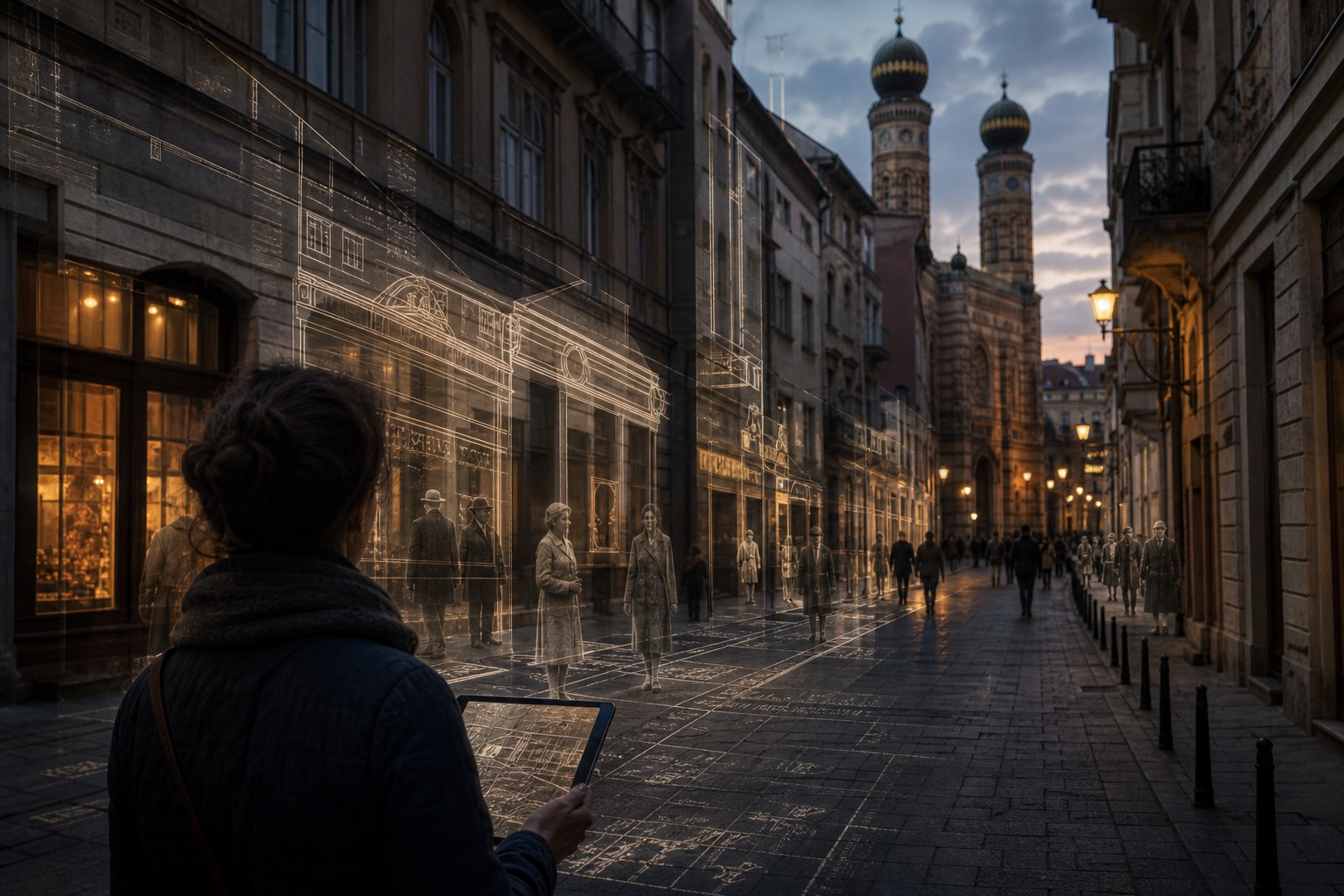
The experience begins in the vibrant Budapest of the early 1900s and leads participants through turning points in the city's history to the liberation of the ghetto in 1945. Characters, digital reconstructions and stories grounded in documented events and survivor testimony appear at their original locations.
The multidisciplinary research brings together history, visual research, anthropology, psychology, film and theatre. AR/XR is not used as spectacle, but as a way to reconnect memory with place and let participants encounter history through movement, perspective and choice.
VISUAL POSITIONING
The experience uses a Visual Positioning System (VPS) to understand the device's position and orientation from the live camera image and mapped urban landmarks. This allows reconstructed storefronts, people, boundaries and narrative events to remain anchored to the physical city with millimetre-level visual alignment.
The device observes façades, corners, signs and stable architectural details.
The camera image is compared with a prepared spatial map of the location.
The system resolves where the participant is standing and which direction the device is facing.
Digital reconstructions are placed over their real-world locations with precise, persistent registration.
RESEARCH & RESPONSIBILITY
Researchers and international experts guide how testimony, archival material and interaction are translated into an experience. The goal is not to gamify trauma, but to create a sensitive, participatory and critically engaged form of digital remembrance.
CURRENT STATUS
Three prototype narratives are being tested to understand emotional impact, spatial interaction and the ethical questions raised by making the past experientially present. The findings will shape the final location-based experience.
Visit the official project website